Make better performance, AI investment, delivery, coaching, product, and development decisions. Track whether they worked.
Aidrian shows you what is happening, why it is happening, what to do next, and what changed after you acted.

Why teams move beyond dashboards
Three signs your dashboard is holding you back
Your dashboard only shows system metrics.
Flow, quality, and delivery data tell you what the systems record. They miss how people experience the work, where collaboration breaks down, and the context shaping performance.
Your dashboard shows what happened, not why.
A metric can reveal that performance changed, but not what caused it. Without the human context behind the numbers, teams and leaders are left interpreting symptoms.
Your dashboard does not show you what to do next.
Even when the problem is visible, the dashboard stops at observation. It does not turn the insight into a practical next step for the people who need to act.
Higher realized ROI on transformation programs
Lower lead time for new products and services
Reduction in wasted tool investments
What makes Aidrian different
Dashboards stop at seeing. Aidrian closes the loop.
A dashboard shows you what is happening and stops there. Aidrian runs the full loop: it shows what is happening, explains why, guides the next step, and measures what happened when you acted. And because it reads the drift early, you improve situations while they are still cheap to improve, not after they have become a crisis.
01 · Combine
Combine system data with human context.
Aidrian brings imported delivery data from the tools your teams use together with input from the people doing the work. System signals show what the tools record. Human signals show how the work is experienced. Together they create a fuller performance picture.

02 · See
See what is really happening.
The team workspace brings both sources into one shared view. Instead of switching between delivery reports and separate conversations, you can see the system signals and the human context together.

03 · Understand
Understand why it is happening.
Aidrian's AI continuously scans system signals and human input for patterns that are easy to miss. It turns those patterns into contextual insights, helping leaders, coaches, and teams see what is changing, what may be driving it, and where to look next.

04 · Act
Act on the next specific step.
Aidrian turns the performance context into focused nudges for the people closest to the work. The next step stays practical, relevant, and present after the conversation ends.

05 · Track
Track what changed after you acted.
Follow team performance over time and use the response to shape the next conversation, nudge, or improvement step. Each cycle starts with more context than the last.

Aidrian gives you one evidence base across every initiative: what changed, what it cost, and what it returned. Funding conversations stop being arguments about belief and become comparisons of measured results.
Every initiative and ways-of-working change is tracked against before-and-after performance data. When the board asks what it returned, you answer with evidence instead of a consultancy report.
Seat counts and code-acceptance rates prove usage, not value. Aidrian measures what changes in cycle time, quality, and cost of delivery when AI enters the workflow.
When an initiative is not moving the numbers it was funded to move, Aidrian shows it, with the evidence attached. Cuts land surgically, capacity moves to what pays off, and the decision does not get relitigated.
When throughput does not match headcount growth, the cause sits inside the system of work. Aidrian finds it, so the next capacity conversation is about fixing the system, not adding people.
Continuous monitoring of every value stream surfaces the friction, rework, and coordination overhead absorbing the capacity you are paying for.
Continuous human signals on engagement and team health surface struggling parts of the organization before your best people leave.
Make delivery more predictable by combining the information in your delivery tools with what teams experience day to day. See the pattern, understand the context, and guide a practical next step.
Bring imported information and human input into a shared team performance model. Build a consistent basis for understanding how teams are doing and where support is needed.
Consider flow and delivery signals alongside quality, collaboration, and the team's experience. Focus improvement on the conditions that help teams deliver sustainably.
Look at delivery patterns together with human context to identify recurring friction, pressure, and quality concerns. Use that picture to focus the next conversation and support step.
Use team reflections and performance changes to revisit what helped and what did not. Reinforce the next improvement through focused nudges in daily work.
Bring observed delivery performance and the team's context into planning conversations. Understand recurring constraints and shape commitments around the conditions in which the team works.
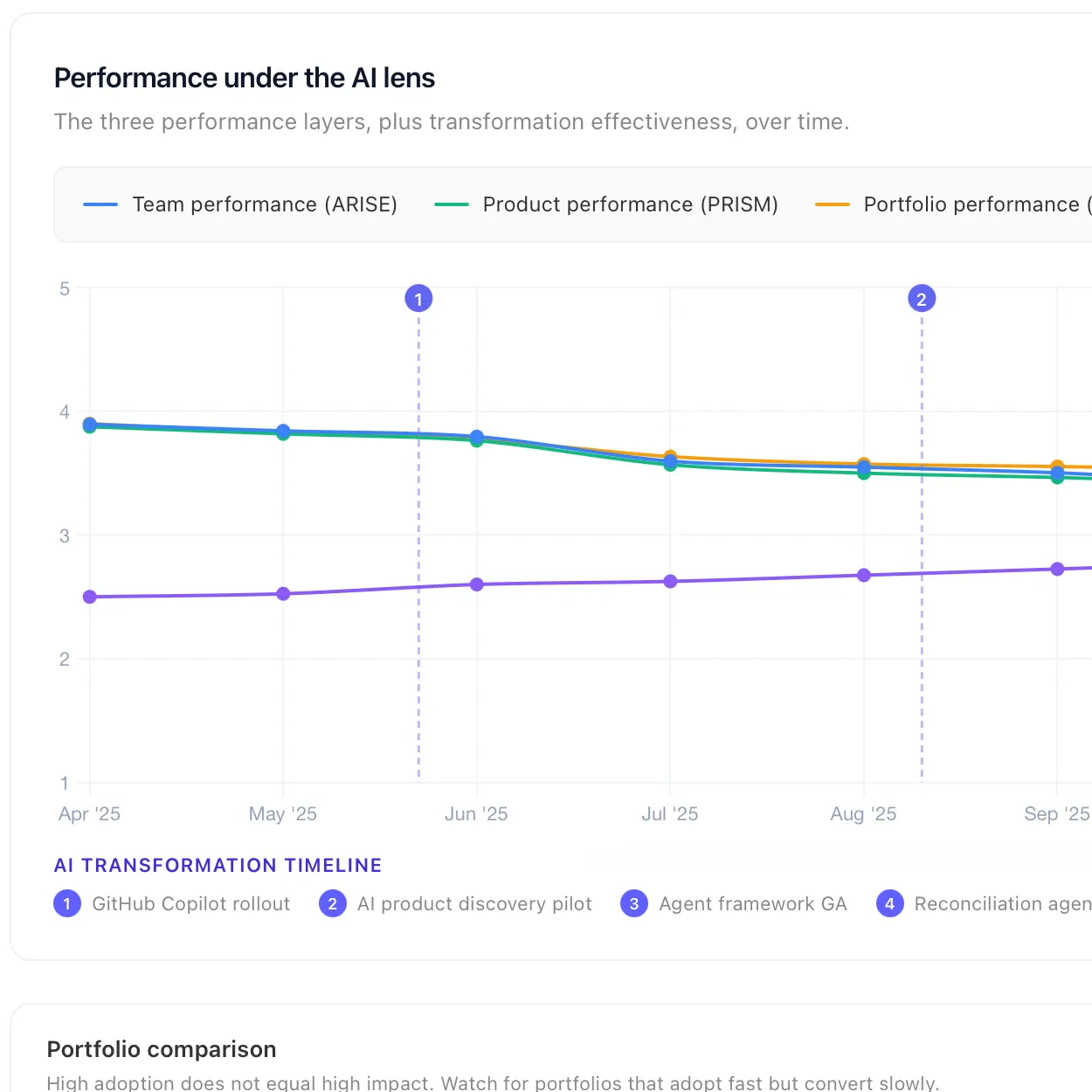
Use changes in team performance as evidence in reviews of improvement initiatives. Combine that evidence with initiative costs and business outcomes in your existing review process.
Make performance context part of everyday leadership decisions. Choose a practical next step, support it through nudges, and follow what changes to inform the next decision.
See where teams need attention, tailor support to their context, and keep improvement moving between conversations. Aidrian helps coaching become continuous, focused, and easier to follow over time.
Use the team workspace to identify which patterns deserve a conversation now, without reconstructing the picture by hand.
Work from the team's own context instead of giving every team the same generic playbook.
Use nudges to keep a chosen improvement present in the flow of work after the coaching conversation ends.
Follow changes in team performance over time and use them to shape the next coaching step.

Bring team performance context into product conversations. Understand the conditions affecting delivery, focus the team on the next improvement, and learn from what happens after you act.
Bring the team's delivery experience and performance context into discovery and planning conversations. Use that perspective alongside customer evidence to challenge assumptions and shape a practical next step.
Ground prioritization in a clearer view of team capacity, friction, and competing demands. Make trade-offs with the people doing the work and keep attention on the outcomes that matter.
Combine imported system signals with the team's experience to understand the conditions affecting flow, predictability, quality, and collaboration.
Follow what changes in team performance after a product or delivery decision. Bring that learning into outcome reviews alongside customer feedback and product results to guide the next decision.
Give conversations about scope, trade-offs, and expectations a shared basis in what the team is experiencing and delivering.
Carry agreed actions into daily work through focused nudges, then follow what changes. Keep improvement moving between retrospectives.
Use a workspace focused on your own development, with nudges that connect improvement to the work you are doing. Reflect, choose a practical next step, and build better habits over time.
Use the individual workspace to understand the signals and development themes most relevant to you.
Receive nudges that turn a broad improvement goal into something practical you can act on.
Keep learning connected to day-to-day work instead of saving every improvement conversation for a formal review.
Use repeated reflection and action to make improvement continuous rather than a one-off intervention.
Aidrian runs on three connected performance models, one per layer of the digital value stream. Portfolio measures how the organization decides and invests. Product measures how products create value and growth. Team measures how teams deliver. Together they trace performance from strategy to outcomes, in one intelligence system. And because every initiative is measured against the same models, before and after, the proof is comparable across every bet you fund.
Portfolio
How the organization decides and invests. Strategic priorities, funding, capacity, governance quality, and how investment decisions translate into value-stream flow and measurable outcomes across the enterprise.
Product
How products create value and growth. Product direction, market positioning, prioritization discipline, execution effectiveness, and whether delivered capabilities translate into adoption, monetization, and business impact.
Team
How teams deliver. Flow, quality, predictability, psychological safety, engagement, and the operational realities of different team types, with guidance for each team's next best action.
Integrations
Aidrian reads the tools your organization already runs. It supports over 100+ enterprise tools, including Jira, GitHub, Confluence, and ServiceNow.
 Jira
 Azure
 GitHub
 GitLab
 Bitbucket
 Confluence
 ServiceNow
 More
Enterprise-grade security
Compliance built for European organisations
With standard EU hosting, your data remains within the EU/EEA and belongs to you. Security and privacy are built into the architecture.
 NIST CSF
 ISO 27701
 OWASP Top 10 ISO 27018 ISO 27017
 CCPA APPI
Here's how easy it is to get started
Start with zero setup
No integrations or implementation plans required. Baseline your first teams in under 10 minutes.
Get your first evidence in weeks
Live performance data shows where investment is producing returns and where it is not.
Scale what the evidence supports
Extend across value streams, and put every new initiative on the record from day one.